Stop Treating LLMs Like Calculators
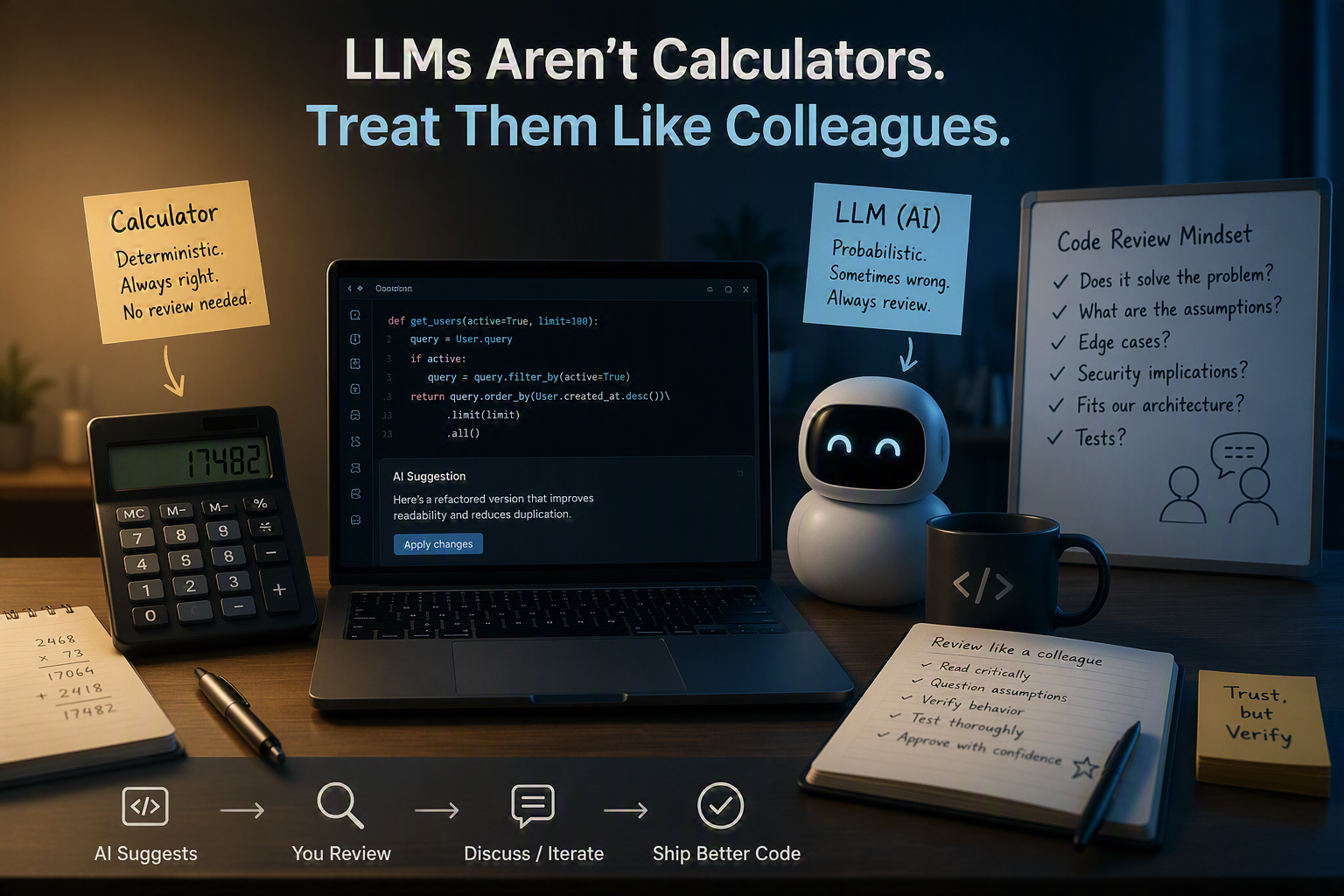
Why Software Developers Should Think of AI More Like a Teammate Than a Tool
The Calculator Problem
When I type a complex calculation into a calculator, I rarely question the result.
If the calculator says the answer is 17,482, I’m inclined to believe it.
If a colleague walks over and tells me the answer is 17,482, my response is very different:
“Are you sure? How did you calculate it?”
The irony is that we’ve started treating Large Language Models more like calculators than like humans. And that’s a mistake.
LLMs Are Not Deterministic Machines
A calculator executes a precisely defined algorithm. Given the same inputs, it reliably produces the same output.
An LLM is fundamentally different. It’s not executing a verified reasoning process. It’s generating the most likely next token based on patterns learned during training. That means the nature of its mistakes is surprisingly human.
It can:
- misunderstand requirements
- make incorrect assumptions
- overlook edge cases
- sound confident while being wrong
- solve a slightly different problem than the one you actually asked
If that sounds familiar, it’s because human developers do exactly the same things. The difference is that many of us instinctively expect perfection from software.
The Trust Gap
Here’s an experiment. Imagine a pull request arrives.
Scenario 1
The PR was created by a new developer who joined three months ago.
You review it carefully.
You inspect the architecture.
You check the edge cases.
You verify the tests.
Scenario 2
The exact same PR was generated by an LLM.
Many developers will spend less time reviewing it. Not because the code is better, but because it came from a machine.
We have decades of experience trusting computers to produce correct outputs. That habit carries over into our interactions with AI.
The problem is that AI-generated code is not the same category of output as a compiler or a calculator result. It is much closer to a code contribution from another engineer.
Research into automation bias describes exactly this tendency: people often trust automated recommendations more than their own judgment, even when verification would be appropriate.
AI Is Turning Programming into Review
One of the biggest changes AI brings to software development is that programming becomes less about writing code and more about evaluating code. Instead of spending thirty minutes writing a feature, you spend five minutes generating it and twenty-five minutes determining whether it’s correct.
This is not a temporary phase. It’s a new skill. In fact, modern discussions around AI-assisted development increasingly frame developers as reviewers of AI-generated artifacts rather than pure authors.
The critical question is no longer:
“Can the AI write code?”
It’s:
“Can I effectively review what the AI wrote?”
The Wrong Goal: Zero Mistakes
A lot of criticism of AI comes down to one observation:
“It still makes mistakes.”
Of course it does. So do humans.
The standard shouldn’t be:
“Is the AI flawless?”
The standard should be:
“Does it make fewer mistakes than the alternative?”
If an LLM helps a developer produce code with:
- fewer bugs
- better tests
- improved documentation
- faster delivery
then demanding perfection misses the point completely.
We don’t require human developers to be flawless before we hire them. We shouldn’t require LLMs to be flawless before we use them.
Review AI the Way You Review People
The best mental model I’ve found is simple:
Treat AI-generated code exactly as you would treat code from a teammate you respect. Not trusted blindly. Not rejected automatically. Reviewed.
Ask questions like:
- Does this actually solve the problem?
- What assumptions is it making?
- What edge cases are missing?
- Does it fit the architecture?
- What happens under production load?
- What security implications exist?
These are the same questions you’d ask during a normal code review.
Nothing special is required. Just the same engineering discipline we’ve always needed.
The Future Is Calibrated Trust
The biggest risk in AI-assisted development isn’t that AI makes mistakes. The biggest risk is that developers forget that it can.
The future isn’t about trusting AI completely. And it isn’t about distrusting AI completely either. It’s about calibrated trust.
Trust it enough to benefit from its speed. Question it enough to catch its mistakes.
In other words:
Treat it less like a calculator and more like a colleague.
Because unlike a calculator, an LLM doesn’t give you answers. It gives you suggestions. And reviewing suggestions has always been part of being a good software engineer.
The Final Question: If One AI Isn’t Enough, What About a Team?
If we accept the premise that an LLM should be treated more like a developer than like a calculator, an interesting question emerges.
Why stop at one?
In software engineering, we rarely trust a single human with complete autonomy. We have design reviews, pull requests, architecture boards, testing teams, security specialists, and production monitoring. Not because humans are bad at their jobs, but because we know that independent perspectives catch mistakes.
So why wouldn’t we organize AI systems in a similar way?
Today, many developers use a single LLM to generate code and then perform the review themselves. But there is nothing fundamentally preventing us from creating an entire “AI team.”
One model generates the implementation. Another reviews it for correctness. A third looks for security concerns. A fourth challenges assumptions. A fifth generates tests designed to break the solution.
At that point, the process starts looking surprisingly familiar. Not because the models are human, but because we’ve recreated the structure of a software team.
The natural objection is that all of these systems can still be wrong.
That’s true. But so can humans.
No code review catches every bug. No architect identifies every design flaw. No test engineer finds every issue.
Software engineering has never been about eliminating mistakes. It’s about reducing the probability that mistakes survive long enough to hurt us. And that leads to a deeper question.
When a team of human developers consistently produces reliable software, we don’t “fully trust” the team in the sense that we believe they are infallible. We trust them because their collective error rate is low enough to be useful.
Perhaps the same standard should apply to AI.
The real question is not:
Can we build an AI team that never makes mistakes?
It’s:
Can we build an AI team whose collective judgment is better than that of the humans it replaces or assists?
If the answer eventually becomes “yes”, then demanding perfection would be an odd requirement. We don’t demand perfection from human teams. We demand competence, accountability, and outcomes.
Maybe the future of software development isn’t a world where developers are replaced by AI. Maybe it’s a world where developers manage and guide increasingly capable teams of AIs, applying the same engineering principles we’ve always applied to human teams: review, verification, defense in depth, and healthy skepticism.
And perhaps that’s the final mental shift. An LLM isn’t a calculator. It’s not even a developer. It’s something new.
But the best way to work with it may still be one of the oldest lessons in software engineering:
Never trust a single source of truth. Build systems of checks and balances, and trust the system more than any individual contributor—human or artificial.